

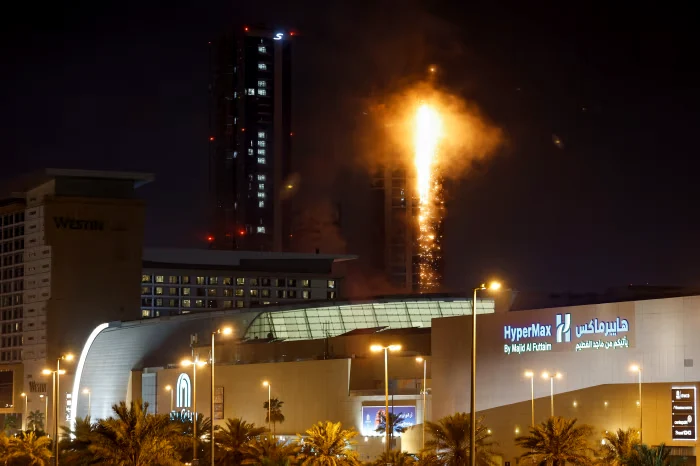
Analiza „Coșmarul suprem” evidențiază furia și frustrarea pe care o resimt statele din Golf în timp ce se confruntă cu un război pe care nu l-au declanșat.
The closure of the Strait of Hormuz is putting pressure on regional economies, while resentment towards the conflict triggered by the US and Israel is growing, writes The Guardian.

A strange calm dominates the industrial port of Ras Al Khaimah. Usually a thriving maritime center of the United Arab Emirates, now the ships are anchored and silent. On the horizon, visible through the mist, hundreds of oil tankers wait, halted in one of the most dangerous maritime routes for commercial transport: the Strait of Hormuz. Just over 20 nautical miles from Ras Al Khaimah, two tankers heading towards the strait were hit by Iranian rockets this week, one catching fire.
On Saturday, Fujairah, the main oil port of the Emirates on the east coast, was the target of a drone attack, and thick black smoke was seen coming from the terminal.
These are just some of the consequences facing the Gulf states, drawn deeper into a war they did not provoke and have tried diplomatically to prevent. For decades, Bahrain, Kuwait, Saudi Arabia, the United Arab Emirates, Qatar, and Oman have allowed the placement of US military bases on their territory and have been among the largest buyers of American arms and technology. In return, the US has been considered the region’s closest and most significant military and protector partner.
However, analysts warn that the relationship is increasingly raising questions after Donald Trump was perceived as sabotaging peaceful diplomatic negotiations to start a war in the Middle East.
„The perceived threat from Iran to the Gulf only became a reality when the US declared war – Iran did not fire first,” says Khaled Almezaini, associate professor of politics and international relations at Zayed University in Abu Dhabi. „There is a strong condemnation of the Iranians, but at the same time the message to Americans and Israelis is clear: a way must be found to end this war. It’s not our war.”
Weeks before the attacks, Gulf leaders hosted negotiations and made repeated appeals to the US president, emphasizing the serious consequences for regional security if Iran were to attack. However, Trump decided to carry out the attacks, widely believed, without consulting or warning Gulf allies.
Although Gulf states expected to be affected by reprisals, the scale of Iran’s retaliatory campaign shocked many of them. The Gulf assured Tehran that no bases on their territory would be used for attacks, but that did not stop Iran from launching thousands of drones and rockets targeting airports, military bases, refineries, ports, hotels, and office buildings.
Air traffic in the region remains heavily restricted, and airlines are recording losses of billions of dollars. Bahrain is facing an economic crisis, and the reputation of the Emirates as a tourist destination and Western investment hub has suffered. Although most Iranian rockets and drones are intercepted, defense systems cost countries like UAE over $2 billion.
The violent blockade of the Strait of Hormuz – the only maritime route connecting the Gulf to the ocean and through which a fifth of global energy passes – has led to a drastic drop in oil and gas exports, which fuel regional economies. Experts estimate daily losses between $700 million and $1.2 billion from exports.
„The Emirates and the Gulf Cooperation Council tried to stop the US from starting this war because they knew the implications,” says Almezaini. He recalled threats made by the Iranian foreign minister just a few months before, regarding the closure of the strait. „Now the exact scenario is unfolding.”
The asymmetry of the military partnership between the Gulf and the US has never been more evident, says Allison Minor, director of the Atlantic Council’s Middle East Integration Project. Just in September, Israel carried out airstrikes on Qatar, another US ally in the Gulf, without triggering a significant reaction from Washington.
„The fundamental question is about consultation,” she says. „Do the Gulf states truly get the military support and partnership they deem necessary if the US engages militarily in the region?”
On Thursday, Oman’s foreign minister, Badr bin Hamad al Busaidi, a mediator in previous negotiations between the US and Iran, made the strongest statements yet.
„Oman’s vision is that military attacks against Iran by the US and Israel are illegal, and as long as they continue, the states that have started the war are violating international law,” Al Busaidi said. He added that the US decision to attack Iran, while negotiations on the Iranian nuclear program were progressing, shows that the conflict is only aimed at reshaping the Middle East in favor of Israel.
Analysts emphasize that many Gulf states are in a contradictory position: trying to temper the conflict, but at the same time wanting the US to finish actions in Iran and not be left with a nightmare scenario – a weakened, hurt, and volatile Islamic republic at their doorstep.
„This is the ultimate nightmare for the Persian Gulf,” says Sanam Vakil, director of the Middle East and North Africa program at Chatham House. „There is deep anger and frustration towards the US because this war is not theirs, yet they bear the consequences.” She adds that Gulf states have long desired a security partnership similar to Israel’s, but have realized that „this may never happen.”
Despite the recognized need to diversify security partners, the Gulf currently has no alternatives to its main protector.
„Gulf states cannot move quickly, nor they can, to find alternatives to the US. But they also don’t want to rely solely on an unreliable partner,” says Vakil. „They will probably continue to pursue strategic autonomy, which was already on their agenda, perhaps at an accelerated pace.”
The economic effects of the conflict have also reached the daily lives of ordinary people. Sumon, 27, who works at a boat and jet ski rental company near the port of Ras Al Khaimah, says their business is paralyzed because no boats are allowed to go out to sea due to tensions and fights with Iran.
„For many days, our boats and jet skis cannot go out to sea because of these problems and the conflict with Iran,” he says. „It’s very bad, we have no customers, and my boss cannot pay me.” Pointing to the opposite port, he adds: „No ship is moving now. Nobody knows when it will end.”
In Iran, anger against the clerical regime and demands for political change have been evident in recent years, fueled by protests against internal repression. In this context, many Iranians have changed their perception of foreign intervention due to human losses and infrastructure destruction, including cities and cultural heritage sites. This reality further complicates any prospect of sustainable peace, as civilians find it increasingly difficult to distinguish between the responsibilities of the regime and foreign forces.
After years of arrests, disappearances, and mass killings of protesters, the hatred of segments of Iran towards the harsh and repressive regime has reached a deep point of despair where many believed Donald Trump’s promise that the US „would come to save them.”
Now, two weeks after the war broke out, after US and Israeli airstrikes killed hundreds of people and targeted residential blocks, shops, fuel depots, and even a school, the mood is changing.
„And they lie! Just like the regime lies to us,” says Amir* (name changed for security reasons), a student at the University of Tehran. „You are all worse than each other.”
The turning point for Amir was the Israeli attack on the fuel depots in Tehran last week, when an attack on the Shahran depot filled the capital with black smoke. Subsequent rain covered trees, houses, and cars with layers of toxic oil.
„Now I truly believe that [the US and Israel] didn’t have a plan. I still hoped I was wrong, but the attack on Shahran changed my perspective on this war,” he says. „If the regime is what you want to hit, even if you believe these depots were used by the regime, where do you draw the line? What happens to us, ordinary Iranians? We rely on this civil infrastructure. Why should our ability to govern our future be taken away from us? Who can rebuild the total ruins?”
Amir confesses that he now lives with constant anxiety that Iran „could turn into another Iraq,” a country invaded by the US in 2003, promising freedom but bringing civil war. Israeli leaders have previously called on Palestinians in Gaza and Lebanese residents to rise up against oppression, only to kill them in large numbers later.
„My heart is so heavy. I have no more tears. Just anger and more anger. Towards this regime, and towards them,” Amir adds, referring to the US and Israel.
Other Iranians interviewed by The Guardian this week have also changed their perspective on the war, especially after the attacks on oil depots, but also after seeing images of affected historical centers.
Among the most severely affected were the Golestan Palace in Tehran, dating back to the 14th century, and the Chehel Sotoon Palace in Isfahan, from the 17th century.
„How will they rebuild … an invaluable part of history?” asks a student from Tehran. „And how will we bring back to life the people who are dying? Is the message from abroad that, just because the regime doesn’t care, the world shouldn’t care either? Is the goal to wipe out our culture and history?”
Analysts suggest that, in the absence of a comprehensive diplomatic strategy, the Persian Gulf is in a delicate position: dependent on the security provided by external partnerships, but reluctant and distrustful of their results. At the same time, geopolitical tensions generate enormous economic pressures, including increased costs for air defense, losses in energy exports, and declines in foreign investments.
Comentarii recente